TRAVEL IN KOREA
Korea Places to Visit
Find attractions, culture, festivals, stays, restaurants, shopping and travel courses for a clear Korea trip plan.

Cheongtaesan National Recreational Forest (국립 청태산자연휴양림)
610, Cheongtaesan-ro, Hoengseong-gun, Gangwon-do
The 1,200-meter-high Cheongtaesan Mountain is a mountain where planted and naturally growing trees flourish in harmony, creating dense forests that provide a habitat for woodland creatures. In the summer, the forest is a convenient stopover for vacationers headed for the East Coast and both children and adults can enjoy learning about the local ecology at the Forest Education Facility.
Cheongun Literature Library (청운문학도서관)
40 , Jahamun-ro 36-gil, Jongno-gu, Seoul
Cheongun Literature Library is located at the foot of Inwangsan Mountain and can be reached by following the mountain's walking trail starting from Changuimun Gate along the fortress wall. This public hanok library is designed in consideration of the sloped topography and the natural scenery of Inwangsan Mountain. The library consists of two floors: an underground floor and a ground floor. While the ground floor is designed as a traditional hanok, the underground floor is made of concrete to support the hanok building and the spacious outdoor yard. By implementing the natural slope in the library's design, the underground southern entrance is exposed, allowing sunlight to enter. The underground floor features a wide collection of books while the ground floor serves as a place for reading. The natural environment surrounding the library adds to the hanok building's traditional and peaceful charms.
Cheongungak Hall (청운각)
35 Cheongun-ro, Mungyeong-si, Gyeongsangbuk-do
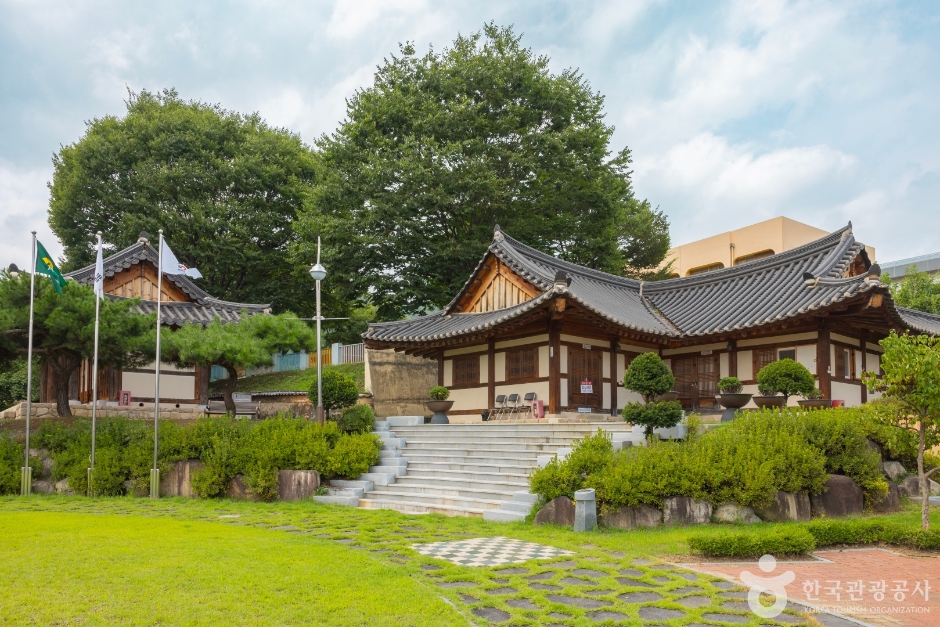
Cheongungak Hall was the living quarters for President Park Chung Hee from 1937 to 1940 while he was working as an elementary school teacher. After becoming president, he would often visit the hall when there were events in the area of Mungyeong. Cheongungak Hall was built in 1928 and is a prime example of 20th century architecture. Currently the hall serves as an exhibition space for photos of the president and items he used during his time here.
Cheongwadae Sarangchae (청와대사랑채)
45 Hyoja-ro 13-gil, Jongno-gu, Seoul
Cheongwadae Sarangchae is an “open cultural space” for everyone. Throughout the facility, travel library-themed spaces and tourism-related exhibitions are set up providing distinctive experiences for visitors interested in learning more about Korea. By exploring Cheongwadae Sarangchae and its surroundings, visitors can expand their discovery and get a deeper insight as they travel Korea. Cheongwadae Sarangchae consists of exhbition halls on the first and second floors, with convenient amenities such as a nursing room, storage lockers, accessible restrooms, a gift shop, and a cafe.
Cheongwansan Provincial Park (천관산도립공원)
Cheongwansan-gil, Jangheung-gun, Jeollanam-do
Cheongwansan Provincial Park is located on Cheongwansan Mountain, which is considered one of the best mountains in southwest Korea, along with Jirisan, Naejangsan, Wolchulsan and Naebyeonsan mountains. The name of Cheongwan comes from the fact that the surrounding boulders resemble a thorny crown worn by an emperor. In autumn, fields of silver grass unfold around the mountain peak, allowing for the Cheongwansan Silver Grass Festival to take place on Yeondaebong (silver grass plain). Also, from the top of the mountain, several grand landmarks like Dadohae archipelago, Wochulsan Mountain and Mudeungsan Mountain in nearby cities can be seen. On a clear day, visitors can even see Hallasan Mountain on Jeju Island. In the middle of the mountain is Cheongwansa Temple, which houses precious cultural properties including Cheongwansa Three-Story Pagoda (Treasure No. 795), Cheongwansa Seokdeung (stone lantern), Five-Story Pagoda, and Jangheung Tapsansaji Seokdeung (stone lantern).
Cheongwon Garden (청원가든)
67 Seonunsa-ro, Asan-myeon, Gochang-gun, Jeonbuk-do
Among the freshwater eel restaurants near the entrance of Seonunsa Temple, this place is well regarded for its clean setting and well-prepared side dishes. 'Jangeogui' (grilled eel) eel is pre-seasoned or lightly sauced in the kitchen, then grilled over charcoal at the table. The spacious seating also makes it suitable for groups.
Cheongyang Daracgol Julmudeom Holy Site (청양 다락골 줄무덤 성지)
78-6, Darakgol-gil, Cheongyang-gun, Chungcheongnam-do
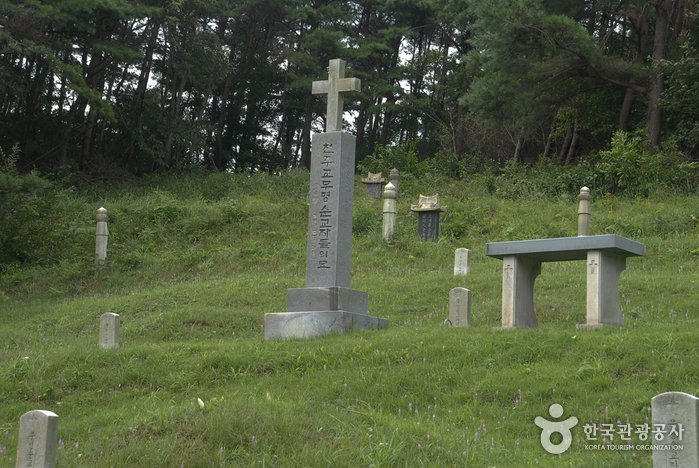
Julmudeom refers to the unmarked graves of anonymous Catholic martyrs in Darakgol, Cheongyang in Chungcheongnam-do. Darakgol is also the birthplace of St. Choi Gyeong-hwan and Choi Yang-eop (the second Catholic priest in Korea) was also martyred in Gwacheon, Gyeonggi-do. Because the grave is of more than one individual, it was given the name Julmudeom (group graveyard). Although the exact number of martyrs and their exact cause of death is unknown, they were buried by family resulting in the 37 mounds in three sections. In 1982, Cheongyang Cathedral established monuments to commemorate the unidentified martyrs, and Julmudeom became a well-known site for Catholic pilgrimages. In 1986, the remains of St. Choi Gyeong-hwan Francisco were relocated to the Jeoldusan Martyrs’ Shrine reducing the total number of mounds at Julmudeom to 36.
Cheonhamu-Bbong(천하무뽕)
서울특별시 종로구 대학로 112 (동숭동) 대학로 이음센터 이음홀

Cheonho-dong Rose Village (천호동 장미마을)
Cheonho-dong, Gangdong-gu, Seoul
Cheonho-dong Rose Village is a place where visitors can see the old neighborhoods of Seoul and the roses that adorn every wall. The small old houses convey the nostalgia of 30 to 40 years ago, and the red and pink roses in full bloom in every house welcome travelers. The street is narrow, but thanks to the residents' careful maintenance, it has become a famous rose attraction and photo spot. The rose season peak from May to June, forming a tunnel of roses. There is also mural that recreates a scene from the novel “The Little Prince,” giving the area a poignant atmosphere. Rose Village is located about 250 meters from Cheonho Station (Seoul Subway Line 5), Exit 1. Visitors are advised to be respectful and to keep the noise level down while touring the area as it is a residential village.
Cheonjangho Lake (천장호)
24-23, Cheonjangho-gil, Cheongyang-gun, Chungcheongnam-do
Cheonjangho Lake is situated on the ridge of Chilgapsan Mountain about 11 kilometers away from the Chilgapsan Recreational Forest. This is reservoir of 1,200 hectares and is used to irrigate nearby farm land. Construction began in 1972 and took seven years to complete. The lake boasts clean water and an outstanding surrounding landscape. When it comes under fog or clouds, it creates a scenic view against the Chilgapsan Mountain landscape. In early spring, smelts are caught in abundance, drawing a growing number of tourists and anglers.
Cheonjangho Suspension Bridge (천장호 출렁다리)
24 Cheonjangho-gil, Jeongsan-myeon, Cheongyang-gun, Chungcheongnam-do
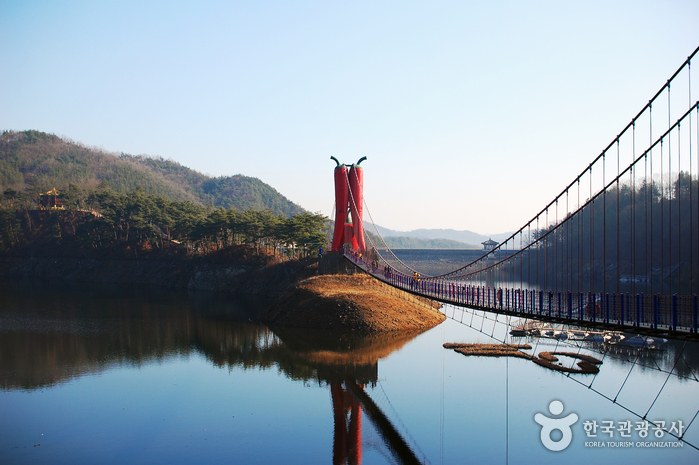
Built in 2009, this emblematic suspension bridge of Cheongyang stretches a total of 207 meters. Its most striking feature is a 16-meter-high main tower in the middle, ingeniously crafted to resemble Goji berries and red peppers, Cheongyang’s proud local produce. Below it is a narrow 1.5-meter-wide, 20-meter-long bridge, which starts to sway subtly both vertically and horizontally, offering a gentle thrill to whoever walks on it. This bridge is engineered to swing up to 30 to 40 centimeters, adding to the excitement of the crossing. Upon reaching the other side, visitors are greeted by an observatory and a trail leading up to Chilgapsan Mountain. For those who prefer a less strenuous journey, a leisurely stroll around Cheonjangho Lake towards Hwangnyongjeong Pavilion is a delightful alternative. The lake, overarched by the suspension bridge and nestled at the foot of Chilgapsan Mountain’s eastern reaches, presents a spectacular vista, rightfully counted among Cheongyang's most celebrated sights. The hiking trail ascends to the top of Chilgapsan Mountain, offering yet another perspective to appreciate the beauty of Cheonjangho Lake, the Cheonjangho Suspension Bridge, verdant forests, and charming valleys. An especially unique experience is visiting the Cheonjangho Suspension Bridge at night when it’s aglow, revealing a mesmerizing nocturnal allure.
Cheonjedan Altar on Taebaeksan Mountain (태백산 천제단)
168, Cheonjedan-gil, Taebaek-si, Gangwon-do
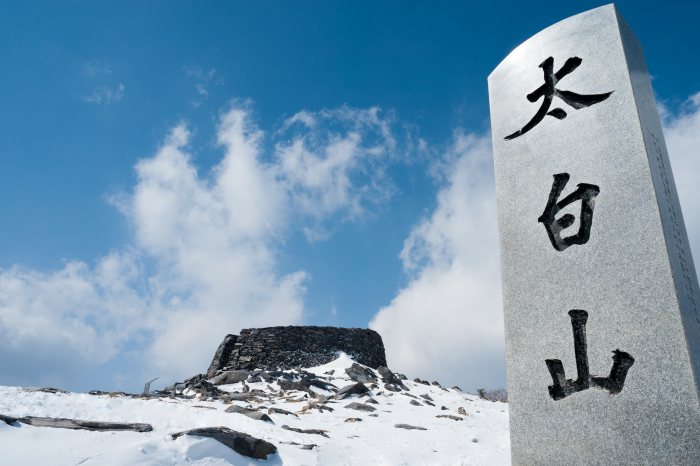
Cheonjedan Altar is a set of altars that were set up by people in the past to offer goods to the heavens. Old records such as the "Samguksagi (History of the Three Kingdoms)" state that the Silla kingdom organized rituals in Taebaeksan Mountain, as it was considered a sacred mountain. Cheonjedan Altar consists of three altars with the main Cheonwangdan Altar at the center; Janggundan Altar to the north; and Hadan Altar (Lower Altar) to the south. The altars were built by stackings stones to serve as a holy fortress. Cheonwangdan Altar is made of natural stones. It has an oval shape and measures 27.5 meters in circumference, 3 meters in x_height.
Cheonjeyeonpokpo Falls (천제연폭포)
132 Cheonjeyeon-ro, Seogwipo-si, Jeju-do
Cheonjeyeonpokpo Falls is named Cheonjeyeon (The Pond of God) because seven nymphs are said to descend from the cloud bridge in the middle of the night, play on the ground for a while, and then ascend back to the sky. The three-tiered waterfall cascading through the dense forest is a breathtaking sight. The water forms a pond off the first waterfall, which flows into the sea via the second and third waterfalls. Visitors can also admire the Seonimgyo Bridge with seven nymphs carved on the side.
Cheonjin Port (천진항)
1737-15, Yeonpyeong-ri, Jeju-si, Jeju-do
Udo Island is the largest of all the smaller islands near Jeju and where the sun rises before anywhere else. It is located at the eastern end of Jeju Island and a popular tourist spot that is always crowded with visitors as there are numerous things to see, eat and enjoy. The island is a bit too big to tour on foot so it is better to enter the island by car, rent an electric scooter or a small electric vehicle once on the island or travel by bus. Udo has two docks located at Cheonjin Port and Haumokdong Port. Cheonjin Port is the gate port into Udo with several electric scooter rental shops, so many tourists get off here. It takes about 10 to 15 minutes from Seongsan Port or Jongdal Port to Cheonjin Port.
![Cheonjiyeonpokpo Falls [UNESCO Global Geopark] (천지연폭포 (제주도 국가지질공원))](http://tong.visitkorea.or.kr/cms/resource/96/2612496_image2_1.jpg)
Cheonjiyeonpokpo Falls [UNESCO Global Geopark] (천지연폭포 (제주도 국가지질공원))
Cheonji-dong, Seogwipo-si, Jeju-do
The water of Cheonjiyeonpokpo Falls appears to fall from the heavens, giving it its name, meaning "sky connected with land." The wooded area around the falls is home to the wild dampalsu trees, designated as Natural Monument, as well as a great variety of rare plants such as brambles, and songyeopnan as well as gusiljappam trees, sanyuja trees (Chinese lemon trees), and camellias. All together, this forest is designated as Natural Monument. The waterfall is 22 meters high, 12 meters wide and 20 meters in depth. The clear and deep water of Cheonjiyeonpokpo Falls is designated as Natural Monument No. 27 and is renowned as a habitat for Mutae eels (Natural Monument).
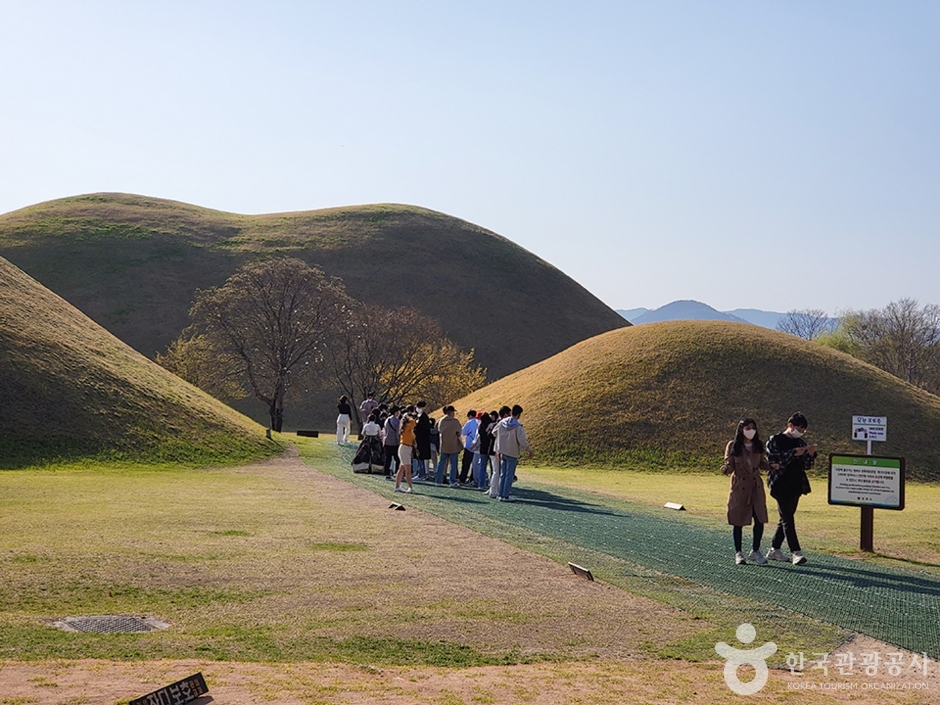
Cheonmachong Tomb (Daereungwon Ancient Tombs) (천마총(대릉원))
9 Gyerim-ro, Gyeongju-si, Gyeongsangbuk-do
Daereungwon Ancient Tombs are one of the most well-known sights in Gyeongju, a history park home to 23 small and large ancient tombs. The area is dotted with tranquil trails among the tombs like the largest tomb in Hwangnam-dong, Hwangnamdaechong Tomb; Cheonmachong Tomb, the place where Cheonmado, a saddle flap painting, was excavated from; and the tomb of King Michu, nicknamed the “Tomb of the Bamboo Warrior.” Cheonmachong Tomb, excavated in 1973, has a x_height of 12.7 meters and a diameter of 50 meters. Its excavation unearthed many artifacts, such as the famous Gold Crown from Cheonmachong Tomb. Its name comes from Cheonmado, a mudguard saddle flap with a painting of a heavenly horse. Cheonmachong Tomb is the only tomb in the Daereungwon Ancient Tombs to be opened to the public. The tomb is thought to have been constructed between the late 5th century and early 6th century. Artifacts excavated from the tomb include a gold crown, gold cap, gold waist belt, gold diadem, and gilt-bronze shoes worn by the buried. The gold crown, in particular, is known as the largest and the most elaborate of all gold crowns unearthed in Korea. The artifacts themselves can be found in Gyeongju National Museum, so don’t miss the chance to see them in person. Another must-visit site is the Daereungwon Magnolia Photo Area, a lone magnolia tree standing between the beautiful curves of ancient tombs.
Plan your Korea trip
Korea travel FAQ
How do I use the travel search?
Enter a place or interest, then narrow the results by region, category or sort order.
Will my filters stay selected on the next page?
Yes. Your search and filter choices stay in the page URL while you move through the results.
Can I find directions to each place?
Place pages include an external Google Maps search when coordinates or an address are available.
Source: Korea Tourism Organization, official website (https://knto.or.kr).